Looking for a property inspection app to help you streamline your ‘Legionnaires Disease Risk Assessment Checklist’ ‘and written report process?
When you set up a job in the Brightchecker system you can use prebuilt survey templates to do just that!
What is a Legionnaires Disease Risk Assessment
Legionnaires Disease is a serious and potentially fatal form of pneumonia caused by the Legionella bacteria. It was first identified in 1976, when an outbreak occurred during an American Legion convention in Philadelphia. Since then, Legionnaires Disease has gained attention as a health concern, and measures have been put in place to prevent and control its spread.
Understanding Legionnaires Disease
Legionnaires Disease gets its name from the outbreak that occurred during the 1976 American Legion convention in Philadelphia. Over 200 attendees fell ill, and 34 people lost their lives. This incident brought attention to the bacteria responsible for the disease, Legionella.
The Legionella bacteria are commonly found in freshwater environments such as lakes and streams. However, they can also grow and multiply in man-made water systems, such as cooling towers, hot tubs, and plumbing systems. When people inhale the Legionella-contaminated water vapor or droplets, they can become infected with Legionnaires Disease.
The History of Legionnaires Disease
The outbreak in Philadelphia in 1976 was a wake-up call for public health officials. It led to the discovery of the Legionella bacterium and prompted extensive research into the disease. Since then, outbreaks and cases of Legionnaires Disease have been reported worldwide, with various degrees of severity. The disease can affect anyone, but certain individuals, such as those with weakened immune systems or underlying health conditions, are more susceptible.
Symptoms and Treatment of Legionnaires Disease
Legionnaires Disease presents with symptoms similar to other types of pneumonia. These can include high fever, chills, cough, shortness of breath, muscle aches, and headaches. In severe cases, individuals may experience chest pain, confusion, and even respiratory failure.
Early diagnosis and treatment are crucial in managing Legionnaires Disease. Antibiotics, such as fluoroquinolones or macrolides, are typically prescribed to kill the bacteria. Supportive care, including oxygen therapy and IV fluids, may be necessary depending on the severity of the illness.
The Importance of a Risk Assessment
Due to the potential severity of Legionnaires Disease outbreaks, conducting a risk assessment is crucial in preventing its spread. A risk assessment is a systematic process that involves identifying potential sources of Legionella contamination, assessing the level of risk, and implementing control measures to minimize the risk of an outbreak occurring.
Preventing Outbreaks of Legionnaires Disease
Preventing outbreaks of Legionnaires Disease starts with understanding how Legionella bacteria can proliferate in water systems. Stagnant water, improper temperature control, and inadequate water treatment are common factors that can contribute to the growth and spread of Legionella.
Regular maintenance and cleaning of water systems, including cooling towers and hot tubs, is essential in preventing the buildup of Legionella. Proper monitoring of water quality, temperature, and disinfection levels can also help reduce the risk of Legionnaires Disease outbreaks.
Legal Requirements for Risk Assessments
In many countries, including the United States and the United Kingdom, there are legal requirements for conducting Legionnaires Disease risk assessments. These regulations aim to ensure that appropriate measures are taken to prevent the spread of Legionella and protect public health.
Compliance with these legal requirements may involve regular inspections, water sampling, and documentation of risk assessment findings and control measures implemented. Failure to comply with these regulations can result in penalties or legal consequences for the responsible parties.
What is Involved in a Legionnaires Disease Risk Assessment?
A Legionnaires Disease risk assessment involves a thorough evaluation of water systems to identify potential sources of Legionella and assess the level of risk associated with each source. It also involves implementing control measures to minimize the risk of an outbreak occurring.
Identifying Potential Sources of Risk
During a Legionnaires Disease risk assessment, potential sources of risk in water systems are identified. This includes examining cooling towers, hot water systems, spas, decorative fountains, and any other water systems that could harbor Legionella bacteria.
Visual inspections, water sample analysis, and examination of maintenance records are common methods used to identify potential sources of risk. Any areas that show signs of contamination or inadequate maintenance are flagged for further investigation and potential remediation.
Assessing the Level of Risk
Once potential sources of risk have been identified, the next step is to assess the level of risk associated with each source. This involves considering factors such as the likelihood of Legionella growth and the potential for aerosolization or inhalation of contaminated water droplets.
Factors such as water temperature, disinfection practices, and system design are taken into account when determining the level of risk. This assessment helps prioritize control measures and allocate resources effectively to minimize the risk of Legionnaires Disease outbreaks.
Implementing Control Measures
Based on the findings of the risk assessment, control measures are implemented to minimize the risk of Legionella contamination and outbreaks. These measures can include regular cleaning and disinfection of water systems, temperature control, water quality monitoring, and employee training on Legionella prevention.
It is important to periodically review and update the control measures to ensure their effectiveness and adjust them as necessary. Ongoing monitoring and maintenance of water systems are crucial to preventing the re-emergence of Legionella and protecting public health.
Who Should Conduct a Legionnaires Disease Risk Assessment?
Legionnaires Disease risk assessments require the expertise of individuals familiar with water systems, Legionella bacteria, and public health guidelines. While anyone can learn about Legionnaires Disease and its prevention, professionals with qualifications and experience in environmental health or water management are best suited for this task.
Qualifications and Experience Required
Professionals conducting Legionnaires Disease risk assessments should have a solid understanding of water systems, Legionella bacteria, and the relevant regulations and guidelines. Qualifications or certifications in environmental health, water management, or occupational health can provide the necessary knowledge and skills.
Additionally, experience in conducting risk assessments and implementing control measures is valuable in ensuring an effective assessment and minimizing the risk of an outbreak occurring.
Hiring a Professional vs. Doing it Yourself
When deciding whether to hire a professional or conduct a Legionnaires Disease risk assessment yourself, several factors should be considered. Conducting a risk assessment requires expertise and knowledge of Legionella prevention measures, water systems, and regulations.
If you have the necessary qualifications, experience, and time to invest in learning about Legionnaires Disease and conducting the assessment, doing it yourself can be a cost-effective option. However, hiring a professional can provide peace of mind and ensure that the assessment is thorough and in compliance with regulations.
Case Studies of Legionnaires Disease Outbreaks
Examining case studies of Legionnaires Disease outbreaks can provide valuable insights into the impact of the disease and the importance of risk assessments. By understanding past outbreaks, we can learn from their mistakes and take proactive measures to prevent future outbreaks.
The Philadelphia Convention Outbreak
The Philadelphia convention in 1976 remains one of the most notable Legionnaires Disease outbreaks. The outbreak resulted in numerous illnesses and deaths, and it served as a catalyst for increased awareness and prevention efforts.
Investigations found that the bacteria had spread through the convention hotel’s cooling towers, which released contaminated aerosols. This incident highlighted the need for regular maintenance and monitoring of cooling towers to prevent Legionella growth and subsequent outbreaks.
Recent Outbreaks and Their Impact
Legionnaires Disease outbreaks continue to occur worldwide, emphasizing the ongoing need for risk assessments. Recent outbreaks have affected vulnerable populations, such as elderly individuals in nursing homes and hospital patients.
These outbreaks highlight the importance of maintaining water systems properly, promptly identifying potential sources of Legionella, and implementing control measures. Risk assessments play a crucial role in preventing and minimizing the impact of Legionnaires Disease outbreaks.
In conclusion
Legionnaires Disease risk assessments are a vital tool in preventing outbreaks and protecting public health. By understanding the history, symptoms, and treatment of Legionnaires Disease, as well as the importance of risk assessments and the steps involved in conducting one, individuals and organizations can take proactive measures to minimize the risk of Legionella contamination and outbreaks.
Whether conducted by a qualified professional or done independently, Legionnaires Disease risk assessments help ensure the safety and well-being of individuals by identifying and mitigating potential sources of Legionella. By learning from past outbreaks and implementing suitable control measures, we can reduce the risk of future Legionnaires Disease outbreaks and protect public health.
Why Use a Brightchecker Digital Checklist?
In today’s fast-paced and demanding work environment, efficiency is key.
With multiple tasks to juggle and deadlines to meet, you need something to come to your rescue.
Look no further than the Brightchecker Inspection App!
Our digital checklist will:
- Give you a clear roadmap to follow, thereby reducing your stress and allowing you to perform at your best.
- Break the job into smaller manageable tasks, thereby making sure nothing is missed and you do not feel overwhelmed.
- Provide common responses, thereby improving efficiency and reducing risk.
- Allow you to enter detailed notes or photos, thereby enabling you to capture condition more precisely, list defects and their severity, and make defect recommendations that call for action.
- Give you a visual reminder of progress, thereby boosting your motivation and propelling you forward.
- Eliminate the need for paper-based inspections and manual report compilation, thereby leading to increased productivity and reduced costs in the long run.
- Safely store completed jobs in the cloud, thereby allowing you to instantly publish reports via a link, pdf, or excel file.
- Act as a starting point for you to develop your own bespoke checklist, thereby reflecting your own inspection procedures and needs. Add new tasks, responses, digital signatures and more.
Checklist/Survey Breakdown
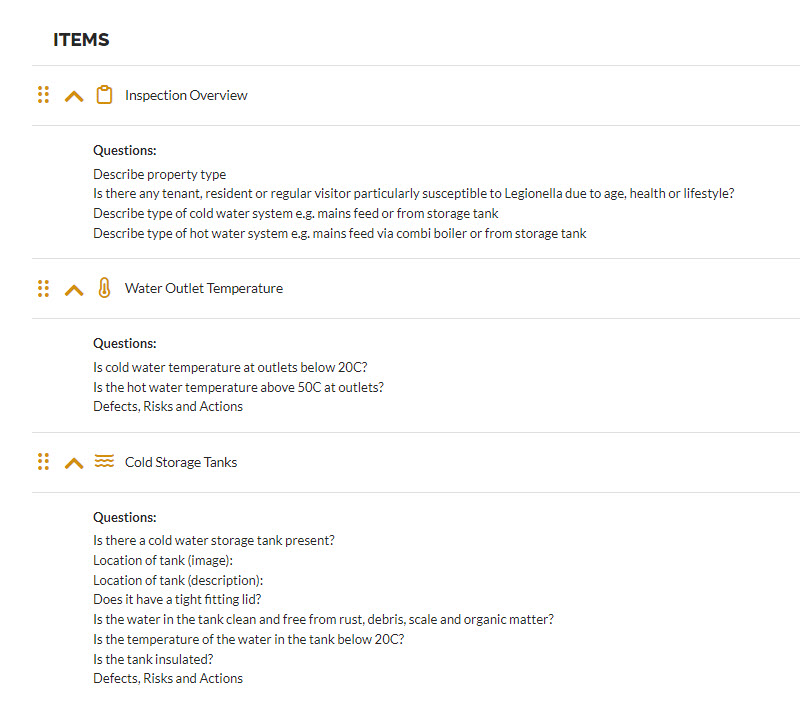
Every checklist/survey structure consists of (1) sections, (2) section items, and (3) item questions.
When you load the survey onto the mobile app, you also see multiple choice options, hints, and instructions.
Section List
: Items & Questions
This is an extract from part of the checklist.